Interesting Times
A rapid response to Zohran Mamdani's momentous victory, and how the Left might prepare for the fight ahead

The impossible has happened.
Zohran Mamdani has won the Democratic primary for mayor of New York City. And not by the hair’s breadth that many expected (or dared to hope), but by such a prodigious margin that his main rival, Andrew Cuomo—state-bestriding ex-governor and hollow-eyed, scandal-ridden ghoul—conceded the race before the first-round ballots were even fully counted. As I celebrated at the Central Brooklyn DSA’s election watch party, I was powerless to stop myself from underlining the miraculous quality of this turn of events to anyone who would listen. Andrew Cuomo has been a scourge on progressive politics in New York for over a decade. That the candidate who finally vanquishes him will also (almost certainly) become the first socialist mayor of New York feels something like receiving a pair of angel’s wings that also cure your inoperable cancer. It is, quoting one former president to another, a big fucking deal.
In his victory speech, Zohran was quick to give credit to his enormous, volunteer-driven canvas operation. I was fortunate enough to pick up a couple shifts myself in the final week. What I found was a dedicated, conscientious, and rigorously organized campaign infrastructure, one unmistakably enmeshed with the vast and now quite influential machinery of the nation’s largest DSA chapter, the driving force behind campaigns for over a dozen of the city’s politicians, from Chi Ossé to AOC. DSA is a large and diverse organization; after every victory its numbers have grown, as they undoubtedly will now. The typical sectarian disagreements of most American left-wing organizations have not brought about its collapse or a split. Now, it has helped to pick the next mayor of New York.
By its very nature, NYC-DSA will continue to operate outside and alongside Zohran’s campaign. Even if he had lost, the organization would dutifully begin planning the next race, the next policy push, the next organizing drive. The chapter’s eco-socialism working group, for instance, is a major pillar in the campaign for publicly-owned renewable energy in New York State, and has considerable success to show for it. But I believe what Zohran and the organization are now about to face is unlike its past elections or long-term campaigns, in which the terms of victory—however hard won—are laid out in polite, anodyne terms. Andrew Cuomo represented more than his own vanity and thirst for power; he represented the interests of real estate, finance, the technology industry, Zionism, and the corrupt political order that enriches both Republicans and Democrats at the expense of the city’s working class. Estranged from voters and from the pulse of the city, and high on the nostrums of centrist reactionaries who preach that the party’s progressive values ought to be abandoned to court those who vote for Trump, these interests believed that Cuomo was the ideal vessel to do their bidding. Now that their maneuver has failed, they will not hesitate to do everything at their disposal to sabotage Zohran and his agenda, to split him from his base, and to drive the city back into the hands of capital—and, if they have to, the hands of fascists.
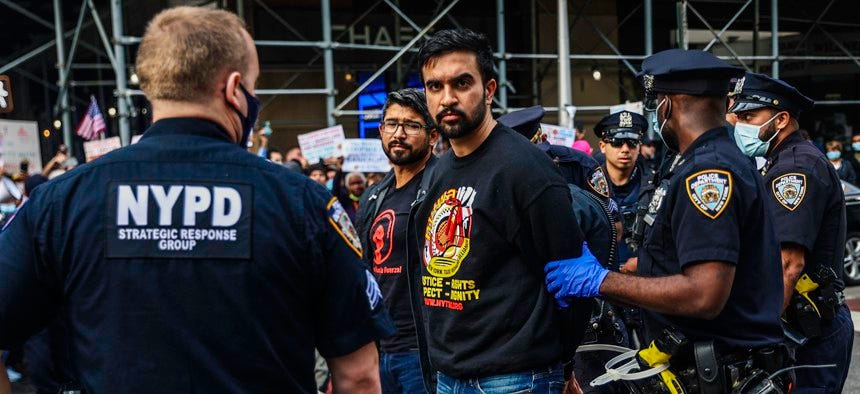
To meet the threat that this presents, with DSA’s help, Zohran’s campaign must not only continue at strength—it must evolve. The political system within the city, the state, the nation, is not designed for a redistributive, populist—let alone radical—agenda like the one Zohran proposes. We can expect forces within the city council, Albany, the NYPD, and even organized labor, to openly conspire to undermine his authority, paralyze his administration, and—one way or another—force him out of office. In so many words, we should expect a coup. My hope is that there is some advantage in acknowledging this before the emergency is upon us.
At a symposium in Summer 2024, I asked the activist and scholar Andreas Malm whether there was a model for the kind of organization that could maneuver in order to win change from intransigent political and economic institutions. His advice was to look to the extra-parliamentary movements in Colombia and Ecuador, who were able not only to safeguard their allies who held political office, but to militate victories that those same allies were too timid to secure on their own. While I’m often reluctant to draw linear comparisons between the terrain within the imperial hegemon and the Global South, in this case it seems to describe a space urgently in need of filling.
NYC-DSA has already proven that it understands three core virtues of an extra-parliamentary organization: communication, discipline, and scale. As the dimensions of the crisis become apparent, a viable organization of this type will demonstrate that it can communicate effectively with the public (and mediate communication between various other constituencies) about what is really going on; maintain discipline across its membership in confrontations both inside and outside the organization; and produce large quantities of people, for canvases, demonstrations, and blockades as needed.
To say more would be premature, but interesting times are upon us.